Blog
Unlock Engineering Insights: Explore Our Technical Articles Now!
eBooks, Whitepapers, & Case Studies
Discover a Wealth of Knowledge – Browse Our eBooks, Whitepapers, and More!
Webinars & Videos
Stay Informed and Inspired – View Our Webinars and Videos Today!
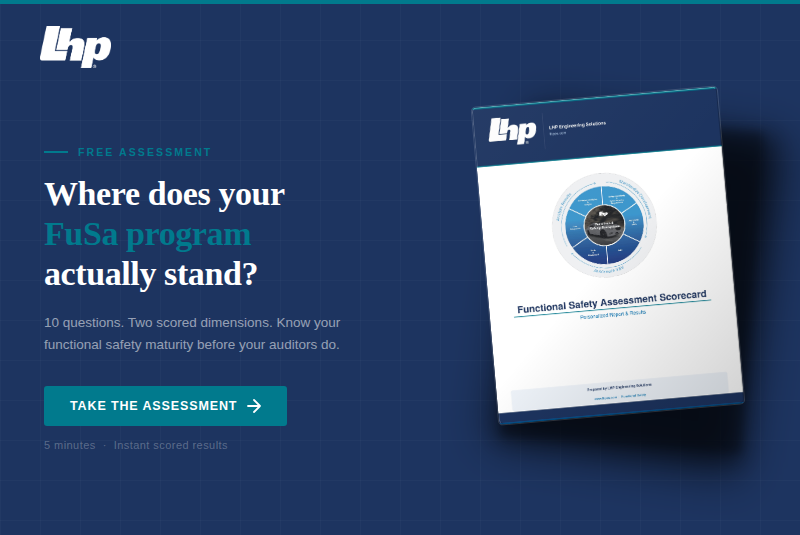
Functional Safety Assessment Scorecard
A 10-question assessment scores your organization across two critical dimensions
Process & Automation
Verification & Validation
ADAS HIL Testing
Accelerating ADAS Development with the LHP ADAS HIL Testing Solution
ADAS HIL Testing
Accelerating ADAS Development with the LHP ADAS HIL Solution
Key Takeaways:
-
ADAS HIL testing replaces hundreds of road-test iterations with simulated edge cases (rain, fog, snow, low light, low-frequency events) covering the equivalent of billions of miles in a controlled, repeatable environment.
-
The LHP ADAS HIL System is the first functional-safety-certified ADAS HIL test system on the market, certified by UL Solutions and the first system certified to integrate scenario-based testing.
-
A connected functional safety ecosystem (ALM + Automated Test Equipment + Configuration Management) ties test cases back to ISO 26262 safety requirements with full bidirectional traceability, eliminating manual data transfer errors and enabling efficient regression testing.
-
The system integrates the full V development flow: requirements, system design, then MIL, SIL, HIL, DIL, and VIL simulation, with sensors and simulators connected to a central control system.
-
Companies entering the functional safety ecosystem follow a defined path: assess test methodology against ISO 26262, close gaps, qualify the toolchain, and certify the test platform with UL Solutions or TÜV Nord.
Why is ADAS development constrained by testing?
Vehicle manufacturers compete on advanced driver-assistance systems (ADAS). Features such as blind-spot detection, forward collision warning, and lane departure warning are now baseline; the competitive frontier has moved to next-generation perception, prediction, and control. At the same time, the driving public expects these features to be both safe and reliable. Many manufacturers are betting that prudent application of standards such as ISO 26262, *Road Vehicles, Functional Safety*, will be sufficient. While that is a step in the right direction, the standard alone does not resolve the tension between rapid feature deployment and the depth of testing needed to verify that ADAS will protect vehicles and their passengers from harm. The resolution lies in a broader **functional safety ecosystem** with a testing approach that supports rapid development without compromising rigor.
What is functional safety in the context of ADAS?
Safety is a primary factor in consumer purchase decisions. Increasingly, occupant welfare depends on the ability of electrical and electronic (E/E) systems to sense, interpret, and respond correctly to the surrounding environment. Functional safety addresses the risks associated with the malfunction or failure of those systems and, by extension, the vehicle's operational safety.
ISO 26262 is the international standard for automotive functional safety. It defines processes to:
- Analyze hazards and assess risks related to the malfunction or failure of E/E systems.
- Establish requirements that reduce risk to acceptable levels.
- Manage and assure the application of those requirements throughout the lifecycle of automotive systems, hardware, and software.
Manufacturers can build a foundation for safe vehicles by implementing ISO 26262, but the standard also introduces testing challenges that it does not address.
What are the testing challenges for ADAS?
To avoid public harm, minimize product liability, and meet consumer expectations, ADAS must be built on requirements-based design and testing. Safety goals are set, systems and components are designed to meet them, and products are validated and verified against them. Functional safety requirements must be tracked through the full development process, not bolted on at the end.
Design and testing must account not only for routine vehicle operation but also for **edge cases**, the events that might not have been anticipated when defining the operational environment but are easily within the realistic driving experience. How should the emergency braking system respond to an animal, a child's toy, or a tumbleweed in the lane? Will sensors perform adequately on a sunny day, in low-light conditions, and through rain, fog, or snow? Edge cases stress ADAS in the less common conditions that determine whether the system is genuinely safe.
Full validation and verification (V&V) of ADAS performance demands many iterations. Manufacturers can install sensors in a vehicle and run multiple cycles on a test track or public roadway, but the time and cost of covering repetitive cases this way are unmanageable. Track and road testing also raise their own safety concerns (consider the risk a test driver takes to find out whether emergency braking works correctly).
Modifications to previously deployed features must also be retested to ensure that seemingly harmless changes have not introduced unexpected problems. Disconnected design and test tools compound the problem: when faced with many test iterations, auditable data flow in requirements-based design becomes onerous (or impossible) if data must be recorded or transferred manually.
Government action adds further pressure. The U.S. Department of Transportation's National Highway Traffic Safety Administration (NHTSA) has outlined a set of principles for the safe operation of automated driving systems, and the European New Car Assessment Program (NCAP) has released a dedicated test and assessment protocol. Manufacturers that have not built flexibility into their design and testing workflows may face uncomfortable adjustments to how they pursue their work.
How can manufacturers resolve ADAS testing challenges?
The resolution is a **functional safety ecosystem** in which standards, processes, and tools are integrated rather than disconnected. Standards and regulations such as ISO 26262 provide the framework and benchmark for building safer ADAS-supported vehicles. Application Lifecycle Management (ALM) provides the proof, in the form of auditable data flow, that design teams are adhering to safety standards while minimizing engineering rework and standardizing across programs. Model-Based Design (MBD) enables software to simulate real-world environments, allowing tests to be run on the computer rather than on the road. Automated test systems, aligned with ISO 26262 and connected to the design tools, accelerate the V&V of safety-critical systems.
(Two adjacent ecosystem elements, AUTOSAR and cybersecurity, also bring substantial value to ADAS and autonomous vehicle development. They are out of scope for this paper.)
A functional safety ecosystem:
- Supports the requirements-based design and testing that builds safety into the product.
- Establishes methods and processes through which software is effectively developed, managed, and controlled.
- Provides an efficient environment for the extensive testing cycles needed to fully verify functional performance.
- Delivers auditable data flow between design and testing.
- Creates flexibility to react to changes in the market and regulatory environment.
The functional safety ecosystem in practice
Manufacturers commonly use a V development flow that begins with the definition of requirements, then proceeds to the design of the overall system, the components, and the controlling software, and then to in-the-loop testing: model in the loop (MIL), software in the loop (SIL), hardware in the loop (HIL), driver in the loop (DIL), and finally vehicle in the loop (VIL) on a dynamometer. In typical practice today, these stages are performed with a variety of independent tools and little data sharing between stages.
The ecosystem instead employs compatible, connected, and automated testing tools. An ADAS workbench can simulate and test actual components in real time, either independently or in concert with related components, as they would behave in the vehicle on the road. All sensors and simulators (including DIL capability) connect to a central control system that manages and records the tests.
A test program built on this approach can cover all functionalities, as many edge cases as can be defined, and many test cycles (billions of equivalent miles if desired) to prove all ADAS functions as specified. Workbench testing in this configuration generates substantially more information faster and reduces the volume of vehicle-on-road testing ultimately required.
The ecosystem supports not only the testing phase but the entire development lifecycle. It ensures that functional safety is fully incorporated by managing and integrating safety requirements, product requirements, design, and testing in an environment that is controlled, repeatable, reviewable, and auditable. Development tools (ALM, software for design, architecture, analysis, and test management) must be compatible, connected, and automated. With connected tools, test cases can be tied back to safety requirements with full bidirectional traceability. No one is manually cutting and pasting data; that saves time, adds flexibility, and removes a major source of human error. The automation also enables efficient regression testing.
What is the LHP ADAS HIL System?
The LHP ADAS HIL System is the first functional-safety-certified ADAS test system on the market and the first system certified to integrate scenario-based testing. It is a full-spectrum, end-to-end solution that integrates the full V workflow.
The system combines ALM with Automated Test Equipment (ATE) and Configuration Management (CM) tools. Test cases established in the ALM tool define the parameters to be tested, pass/fail criteria, test procedure IDs, and ATE configuration IDs. The ALM interface pulls this data and feeds it into ATE test procedures, optionally pulling ATE configuration and controlled test procedures from a CM tool. After test execution, the ALM interface pushes measured parameters and test results back to the ALM tool or an alternate location.
The test workstation orchestrates camera, radar, and LIDAR target simulators alongside HIL and scenario simulators that exercise the device-under-test (DUT) ECU via CAN, LIN, and Ethernet. A car model in the simulator provides the vehicle dynamics. The test executive coordinates test conditions, configures the DUT and sensor simulators, executes test cases and sensor stimulation, collects and traces results, and pushes results back to ALM. The platform complies with current functional safety standards and, due to its modular and scalable nature, can be modified to accommodate the next generation of ADAS test methods as they are required or regulated.
How do companies move into the functional safety ecosystem?
Companies that want to take advantage of the functional safety ecosystem should consider these steps:
1. Assess current test methodology against functional safety requirements.
2. Generate an action plan to close gaps.
3. Produce or upgrade test cases.
4. Qualify the toolchain.
5. Develop a scenario-based systems approach.
6. Design and deliver an upgraded test platform with integrated and automated tools.
7. Certify the test platform with UL Solutions or TÜV Nord.
8. Implement a safe, fast, cost-effective V&V process.
Entering this ecosystem can seem daunting from the outside. Expert guidance from LHP can shorten the path.
Summary
The driving public expects reliable, trustworthy vehicles. Manufacturers want quality, error-free products produced efficiently. These objectives are met within a functional safety ecosystem built on accepted standards and integrated, automated tools.
Frequently asked questions
Q. What is ADAS HIL testing?
A. ADAS HIL (hardware-in-the-loop) testing exercises ADAS components and ECUs against simulated sensor inputs and vehicle dynamics, in a controlled environment that replaces or supplements road testing. A typical setup connects camera, radar, and LIDAR target simulators to the device under test through CAN, LIN, or Ethernet, with a scenario simulator and a vehicle dynamics model providing the operating environment. HIL testing reproduces edge cases (rain, fog, snow, low-frequency events, regulatory test scenarios) at scale, supporting the equivalent of billions of test miles without the time, cost, or safety concerns of vehicle-based testing.
Q. Why is ISO 26262 compliance important for ADAS development?
A. ISO 26262 is the international standard for automotive functional safety. It defines processes for analyzing hazards, establishing safety requirements that reduce risk to acceptable levels, and managing those requirements through the full lifecycle of automotive systems, hardware, and software. For ADAS, ISO 26262 compliance means safety-critical features (emergency braking, lane keeping, adaptive cruise) are built on a defensible engineering foundation that demonstrates the system has been analyzed for failure modes and verified against its safety goals. Without ISO 26262 discipline, ADAS development is exposed to public harm, product liability, and regulatory action.
Q. What makes the LHP ADAS HIL System different?
A. The LHP ADAS HIL System is the first functional-safety-certified ADAS HIL test system on the market and the first certified to integrate scenario-based testing. The certification (by UL Solutions) means the test system itself is qualified for use in safety-critical V&V work, removing one of the audit risks in an ADAS program. The system integrates ALM, ATE, and CM tools so that test cases trace bidirectionally to safety requirements, and is modular and scalable to accommodate the next generation of ADAS test methods.
Q. What is bidirectional traceability in ADAS testing?
A. Bidirectional traceability means every test case can be traced both forward (from a safety requirement to the tests that verify it) and backward (from a test result to the safety requirement it satisfies). It is what allows an ISO 26262 audit to confirm that no safety requirement was lost between definition and verification. In a connected functional safety ecosystem, traceability is automated through ALM and ATE integration, eliminating the manual data transfer that is the largest source of audit risk in disconnected toolchains.
Q. How does scenario-based testing fit into ADAS development?
A. Scenario-based testing exercises ADAS against defined operational scenarios (e.g., a pedestrian stepping out from a parked vehicle, a child's toy on the roadway, sensor performance through fog at dusk). Each scenario is a structured input the test system can replay across many test cycles and many parameter variations, including the edge cases that road testing may never encounter. Scenario-based testing aligns with regulatory frameworks such as the European NCAP test and assessment protocol and the NHTSA principles for automated driving systems, and is what the LHP ADAS HIL System is certified to integrate.
Q. Who certifies the LHP ADAS HIL System?
A. UL Solutions certified the LHP ADAS HIL System. UL Solutions is one of two primary certifying bodies for automotive functional safety (TÜV Nord is the other). Certification by UL Solutions confirms the test system meets ISO 26262 requirements for use in safety-critical V&V, which means programs using the system inherit the certification benefit rather than re-justifying the test infrastructure on every audit.