6 min read

How to scope a safety-critical engineering program before you commit the budget

How to scope a safety-critical engineering program before you commit the budget
11:57

Key takeaways

  • Safety-critical programs that skip a formal scoping engagement often surface scope gaps during paid execution, the most expensive time to find them.
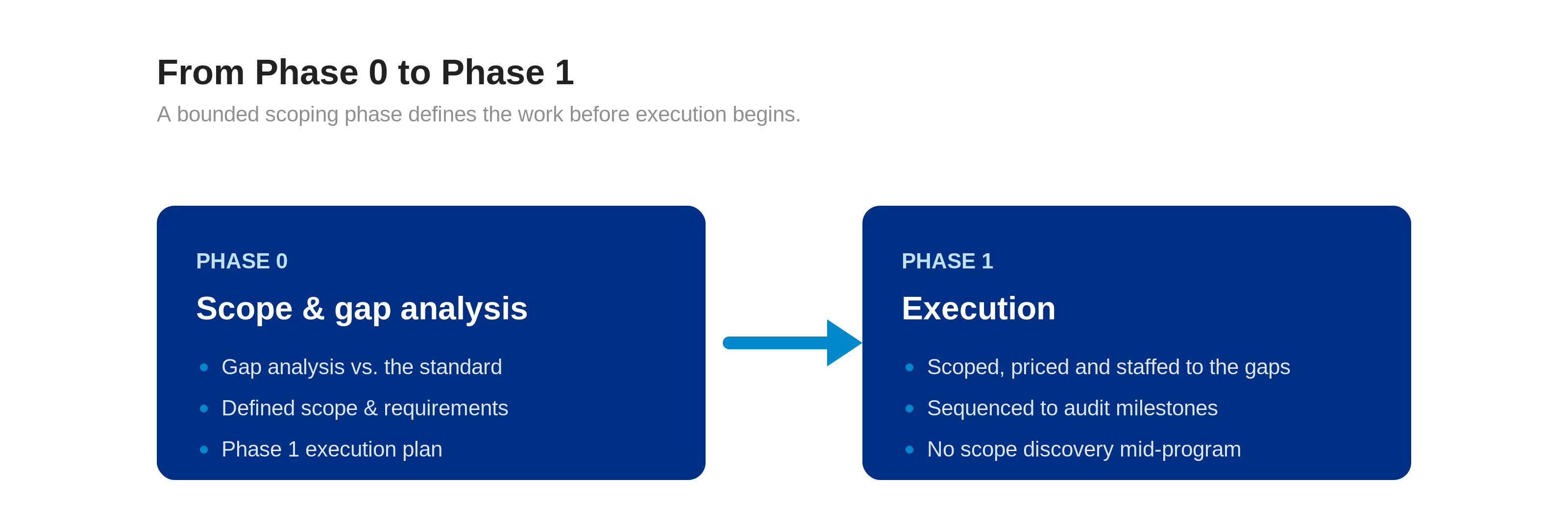
  • A structured scoping phase produces three concrete deliverables: a gap analysis against the relevant standard, a defined scope and requirements, and a Phase 1 execution plan.
  • A paid scoping engagement differs from free pre-sales discovery: the deliverables have standalone value and are usable regardless of which partner executes Phase 1.
  • One LHP Phase 0 engagement with an automotive components and parts supplier grew from a 3-program pilot to 15 active programs after the scope was defined upfront.
  • The clearest signal that a scoping phase is mandatory: your team cannot estimate the program without first understanding what is already in place.

The pattern surfaces often enough that LHP's engagement teams recognize it immediately. An engineering leader approaches a services partner with a specific request: implement ISO 26262 (Functional Safety for Road Vehicles) on a new platform, bring the development organization to Automotive Software Process Improvement and Capability Determination (ASPICE) Level 3 before the next OEM audit, or validate the system architecture before hardware lock. The partner scopes the work based on the client's description. The engagement starts.

Then the discovery begins.

Formal system requirements do not exist above the subsystem level. The existing safety plan references a prior-generation architecture. The work products that should anchor ASPICE evidence for base practices SWE.3 and SWE.4 have never been created in an auditable form. None of this was visible before the engagement started. None of it was priced.

Scope discovery during paid execution is not unique to poorly managed programs. It is the predictable result of skipping a bounded scoping phase before the work begins.

Why this matters now

Automotive programs now routinely face concurrent compliance requirements: ISO 26262 for functional safety, ASPICE for process maturity, ISO 21434 (Automotive Cybersecurity Engineering) for cybersecurity management, and ISO 21448 (Safety of the Intended Functionality, or SOTIF) for programs with advanced driver assistance features. When a program must satisfy multiple overlapping standards, the gap between what the client believes is needed and what the program actually requires grows. That gap is far less expensive to close before an engagement starts than to close it mid-execution.

2026-06-01_Blog_phase-0_diagram-1_phase-0-to-phase-1

What goes wrong when scope discovery happens during paid execution?

Unplanned scope discovery during a paid engagement creates four compounding problems.

The discovery phase is billed. The first weeks are absorbed by learning what the program requires rather than advancing the primary objective.

Estimates become unreliable. The original scope was built on incomplete information. Revised estimates arrive from a team already behind schedule and working with newly surfaced constraints.

Adjacent requirements arrive too late. An ISO 26262 program that reveals a SOTIF dependency three months into a six-month timeline does not adapt easily. Work products completed under narrower assumptions may need to be revisited.

Program relationships bear the cost. The engineering partner is doing the right thing by surfacing the gaps, but the client is surprised, and the conversation is straining trust.

None of these outcomes results from poor intent. They are structural, and they have a structural solution.

What does a formal scoping phase actually produce?

A structured scoping phase performed before full-program commitment produces three categories of deliverables.

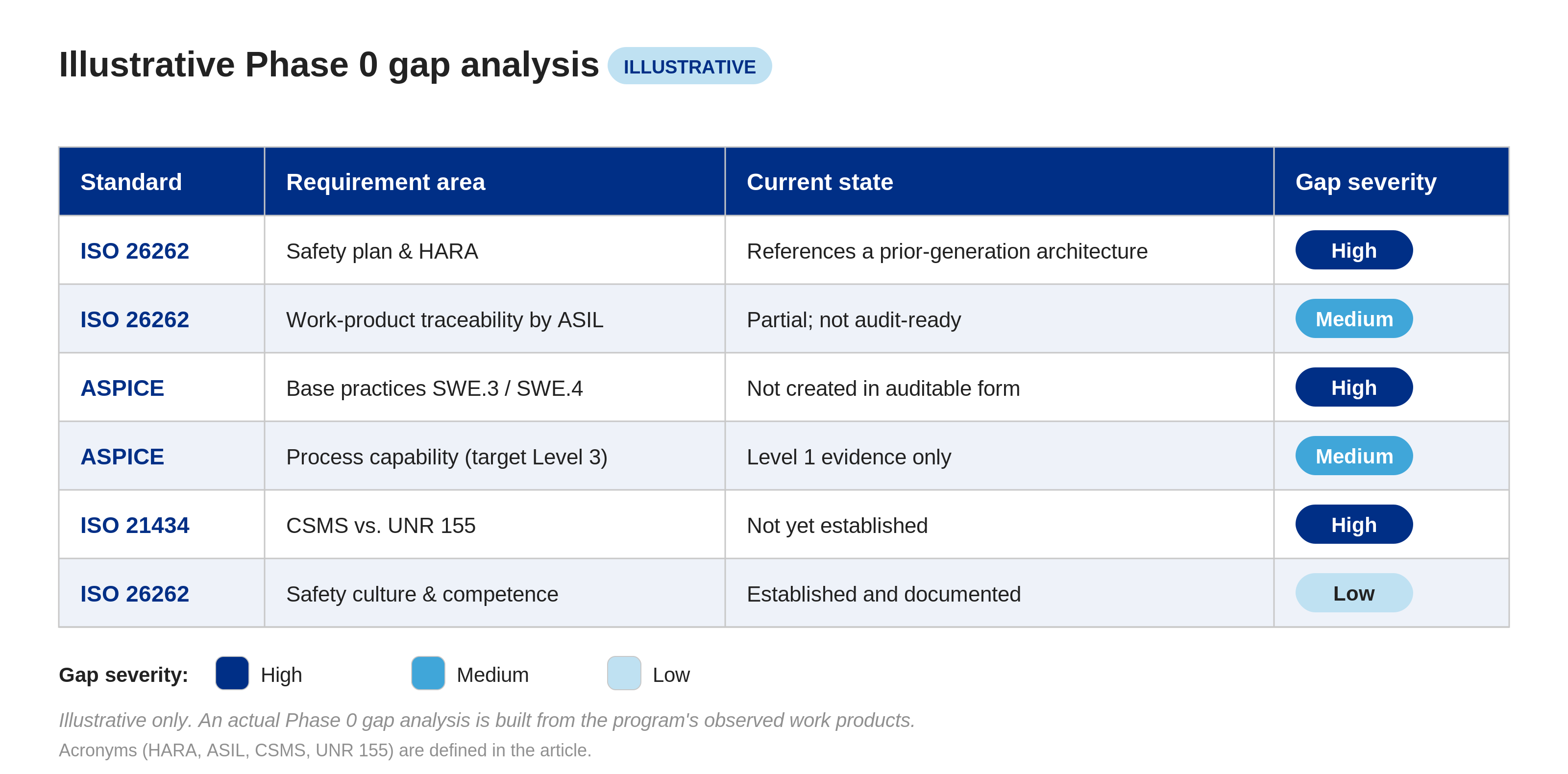
A gap analysis against the relevant standard. For ISO 26262 programs, this maps existing processes, documentation, and work products against the requirements of the applicable standard parts at the appropriate Automotive Safety Integrity Level (ASIL). For ASPICE, it scores current capability against base-practice requirements at each targeted maturity level. For ISO 21434, it assesses the Cybersecurity Management System (CSMS) against the requirements of UN Regulation No. 155 (UNR 155).

A defined scope and requirements for Phase 1. Not an estimate built on assumptions, but a scope built on what was actually observed. The scoping engagement produces the requirements that the engineering partner uses to price and plan the work that follows.

A Phase 1 execution plan. A schedule-aware plan for the work that needs to happen, sequenced against the client's audit or program milestones and staffed against the identified gaps.

These deliverables have standalone value. A client who goes through a scoping engagement and chooses a different partner for Phase 1 still leaves with a gap analysis, scope definition, and plan they can use. A scoping engagement that produces deliverables usable only through continued work with the same partner is a sales qualification process, not a scoping engagement.

2026-06-01_Blog_phase-0_diagram-2_gap-analysis-illustrative

When is a scoping phase worth the investment?

Three conditions make a scoping phase effectively mandatory.

First-time standards implementation. An organization implementing ISO 26262 for the first time has no established baseline. There is no way to estimate the program accurately without first understanding what is in place and what is missing.

Inherited or uncertain compliance history. A platform acquired from another organization, or a program that has undergone development-team transitions, often carries compliance artifacts of unknown quality. Scope discovery in this situation is almost certain without an upfront assessment.

Compressed timelines with fixed audit dates. When the client faces a firm OEM audit date or program gate, there is no recovery time for mid-program scope gaps. The upfront investment in a scoping phase is a fraction of the cost of a failed audit or delayed gate.

How LHP approaches it

LHP's Phase 0 is a paid, bounded-scope engagement conducted by senior consultants before a full program begins. It produces a gap analysis, a defined scope and requirements, and a Phase 1 execution plan. The engagement is intentionally short and structured; it is not an open-ended consulting retainer.

An automotive components and parts supplier engaged LHP for a Phase 0 qualitative assessment of its software development processes. As a direct outcome, LHP was awarded a Phase 1 pilot on three complex programs. That engagement has since grown to 15 active programs with the same client.

Phase 0 applies across LHP's service areas: functional safety, ASPICE and process compliance, ADAS verification, and cybersecurity program readiness. The engagement structure adapts to the standard and program type; the output shape (gap analysis, scope definition, Phase 1 plan) is consistent.

For additional context, see how LHP transforms engineering organizations through structured engagements and ASPICE and functional safety in practice for the broader compliance context, which Phase 0 typically precedes.

What this means for your next program

If your next program involves a new compliance standard, a new product category, or a platform with an uncertain compliance history, the time to address scope uncertainty is before the engagement starts. The deliverables that Phase 0 produces are the same ones that would be produced during paid execution anyway, just earlier and under lower schedule pressure.

Contact LHP at lhpes.com/contact if you are planning a safety-critical engineering program in the next two quarters. The right time to start the conversation is before the program is already behind.


FAQs

What is Phase 0 in engineering program delivery?

Phase 0 is a bounded, paid scoping engagement performed before a full engineering program begins. It produces a gap analysis against the relevant standard (ISO 26262, ASPICE, or ISO 21434), a defined scope and requirements, and a Phase 1 execution plan. Deliverables have standalone value regardless of which partner executes Phase 1.

What is the difference between a Phase 0 scoping engagement and a free pre-sales discovery call?

A pre-sales discovery call gathers information that the seller uses to build a proposal. A Phase 0 engagement is a paid service that produces deliverables the client keeps: gap analysis, scope definition, and a Phase 1 execution plan. The client receives value from Phase 0 regardless of whether they proceed with the same partner. Phase 0 is a program investment, not a procurement conversation.

Which types of programs benefit most from a scoping phase before execution?

Programs where unplanned scope discovery carries the highest cost: first-time implementations of ISO 26262, ASPICE, or ISO 21434; programs with an inherited compliance history of uncertain quality; and programs with compressed timelines and fixed audit dates. Surfacing scope during paid execution narrows options at exactly the point when those options should be open.

How does a Phase 0 scoping engagement interact with ASPICE and ISO 26262 programs specifically?

For ASPICE, Phase 0 includes a base-practice gap assessment at the target maturity level, identifying which process areas (SWE, SUP, and MAN practice groups) need the most development before a formal assessment. For ISO 26262, Phase 0 maps existing work products against the standard's requirements by ASIL, identifying gaps that would fail a functional safety audit. In both cases, the gap analysis becomes the Phase 1 planning input rather than a discovery that surfaces mid-execution.

About LHP Engineering Solutions

Since 2001, LHP Engineering Solutions has helped companies deliver technology that must perform as intended, every time. Our clients operate in safety-critical, operation-critical, and mission-critical environments such as on-highway, off-highway, aerospace, defense, and oil & gas, where failure is not an option, and delays cost market share.

LHP helps organizations design, architect, validate, and monitor complex systems. Our global team of engineers supports the development of advanced technologies, including high-voltage power electronics, hybrid and electric powertrain controls, connectivity, and ADAS platforms, enabling OEMs and Tier-1 suppliers to bring next-generation products to market quickly and with confidence.

In compliance-driven industries, LHP uses our model-based systems engineering (MBSE) approach, enhanced through AI, to help companies move quickly while meeting rigorous standards, including functional safety, ASPICE, and cybersecurity. Our teams have helped global technology companies achieve functional safety certification and ASPICE compliance in months rather than years, and established enterprise-grade safety and cybersecurity management systems for leading OEMs.

When organizations must make major technology leaps, such as launching next-generation platforms, future-proofing vehicle architectures, or proving new concepts to secure market-defining programs, LHP delivers the engineering disciplines, solutions, and on-time execution required to succeed.

Because in industries where technology must perform as intended, precision engineering matters.

Additional Content

Stop Wasting Money: The Simple Truth that Could Save Your Engineering Budget Millions

Stop Wasting Money: The Simple Truth that Could Save Your Engineering Budget Millions

{% video_player "embed_player" overrideable=False, type='hsvideo2', hide_playlist=True, viral_sharing=False, embed_button=False, autoplay=False,...


Read More
How to Ensure Your Vendor-Purchased Safety Integrity Level Packages Are Compliant

How to Ensure Your Vendor-Purchased Safety Integrity Level Packages Are Compliant

If you purchase prebuilt (Automotive) Safety Integrity Level – ISO 26262/IEC 61508 or other – packages, what kind of guarantees do you need from the...

Read More
The Role of AI in Modern Systems Engineering for Safety-Critical Processes

The Role of AI in Modern Systems Engineering for Safety-Critical Processes

{% video_player "embed_player" overrideable=False, type='hsvideo2', hide_playlist=True, viral_sharing=False, embed_button=False, autoplay=False,...
Read More
A Cleaner Powertrain Design Driven by Stringent Emission Standards

A Cleaner Powertrain Design Driven by Stringent Emission Standards

When Toyota launched the first Prius in 1997, many consumers probably didn’t imagine that just 20 short years later the electric- and hybrid-vehicle...

Read More