


 Marty Muse
What is the Internet of Things?
What Is IoT? It is impossible to go very long without hearing that IoT, Machine Learning, Cloud Computing, and AI are going to completely transform...

An engineering VP at a Tier-1 supplier was recently asked the same question by two stakeholders in the same week. Procurement asked, "How much faster can your team move with the new AI tools?" The safety manager asked, "How do we qualify any of those AI outputs for the ISO 26262 safety case?" Both questions are reasonable. Both deserve an honest answer. The honest answer is that AI in safety-critical engineering accelerates some workflows and quietly creates audit risk in others. The firms that pull ahead in 2026 will be the ones that can tell the difference.
AI coding assistants and AI-generated documentation are now defaults across most engineering tool suites. Suppliers are being asked to demonstrate productivity gains on existing programs. At the same time, the regulatory and assessor communities have caught up. ISO/IEC TR 5469:2024 (Functional safety and AI systems), published January 2024, is now a public technical report and is appearing in audit conversations. The European Union's Artificial Intelligence Act (Regulation (EU) 2024/1689), which entered into force on 1 August 2024, classifies AI systems that serve as safety components of regulated products such as vehicles or industrial machinery as high-risk under Article 6, layering conformity assessment, transparency, and risk management duties on top of existing functional safety practice. The obligations for high-risk AI embedded in regulated products apply from 2 August 2028 under the Act's extended transition. Automotive Software Process Improvement and Capability Determination (ASPICE) 4.0 assessors, working from the December 2023 VDA QMC release, have started asking pointed questions about provenance: who or what generated this artifact, what evidence supports its correctness, and where does its trace originate.
Most engineering organizations have moved faster on adoption than on governance. The result is that AI-accelerated work is reaching safety-case territory before the safety case knows it. The cost of finding out at audit time, rather than at design time, is measured in months of rework on a Start-of-Production (SOP) bound program.
The pattern across LHP engagements, and across the field generally, is that AI is genuinely useful for high-volume, lower-criticality, evidence-light tasks at the front end of the V-model. Four categories repeat:
In each case, the acceleration is real because the artifact is reviewable and its correctness can be checked against an existing source of truth. The AI is faster than a human at the rough draft. The human is still the author of record.
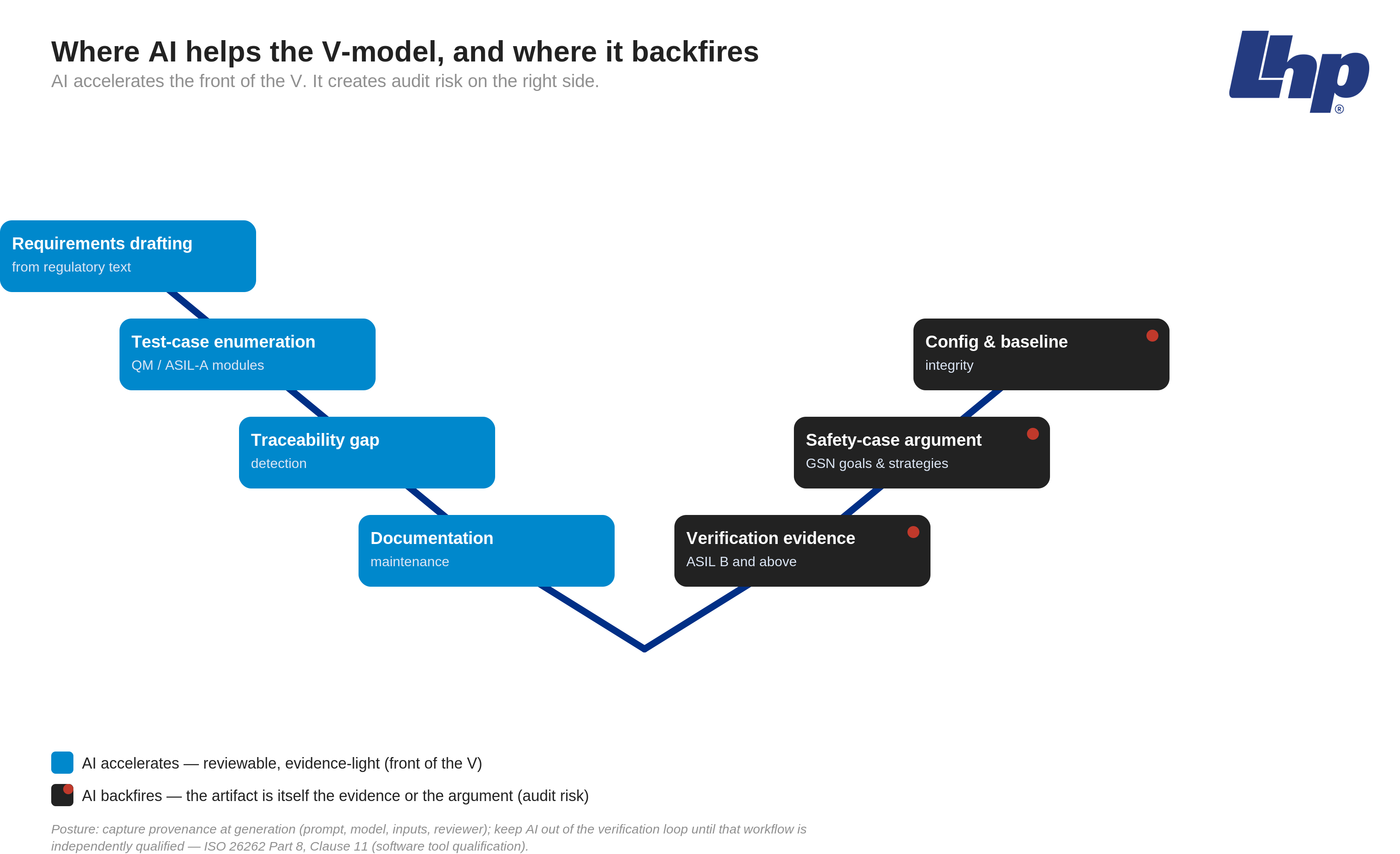
The failure pattern is the opposite. AI-augmented work creates audit risk when the artifact itself is the source of truth, the verification evidence, or the safety argument. Three categories show up in audit findings repeatedly:
The pattern across all three is the same. AI-generated artifacts require provenance to be included in a safety case. Most teams generate first and worry about provenance second, which is the wrong order.
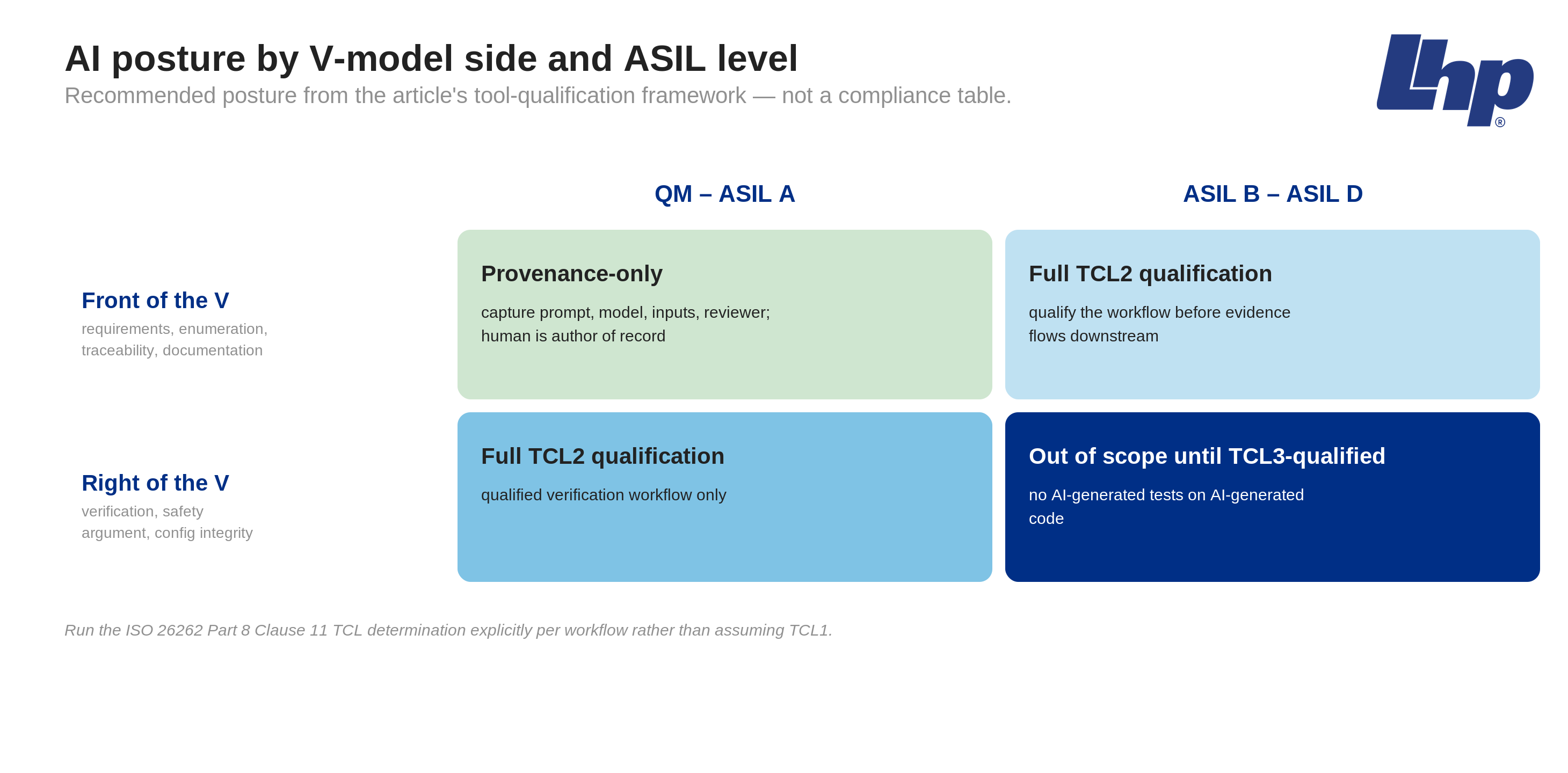
The qualification question is concrete: what evidence does an assessor accept for a safety-critical artifact that was AI-assisted? The answer LHP applies to engagements is borrowed from software tool qualification practice under ISO 26262 Part 8 Clause 11. Treat the AI workflow as a tool. Define its tool confidence level (TCL) based on the impact of an undetected error and the likelihood that the workflow will detect such an error before integration. The standard's TCL determination procedure is what governs whether qualification is required for a given workflow; the defensible posture for generative AI in safety-relevant work is to perform the TCL evaluation explicitly per Clause 11 before assuming the workflow can pass at TCL1.
The practical consequence is a small set of operational rules:
Working engineers can apply this without waiting for organizational policy. The provenance discipline alone removes most of the audit risk because it makes the AI contribution legible and auditable on demand.
LHP integrates AI-augmented workflows into model-based systems engineering (MBSE), functional safety, and ASPICE engagements with three guardrails. First, every AI-generated artifact carries a provenance record before it can be cited downstream. Second, the AI workflow itself is qualified at the program's highest applicable TCL, and the qualification record is maintained alongside the toolchain configuration baseline. Third, AI usage is mapped explicitly to the V-model: high-volume, reviewable activities on the left side of the V; tightly controlled or absent on the right side until the verification workflow is independently qualified. The result is faster front-end work without the audit liability that unmanaged AI adoption tends to produce. The methodology is tool-agnostic and has been applied across LLM-based requirements assistants, AI-augmented modeling tools, and code-generation assistants.
The decision in front of most engineering leaders in 2026 is not whether to allow AI tools. The procurement question and the productivity question have already been settled. The decision is whether AI usage will be governed before audit time or after. The first costs an explicit policy and a small upfront tooling investment. The second costs program time on the next assessment, and on safety-critical programs, program time is launch time.
The next concrete step worth taking this quarter: identify three workflows where AI is already being used inside your engineering organization. For each, write down the provenance record that would be required if the assessor asked tomorrow. The gap between what is captured and what is required is the size of the policy you need to put in place.
Not by default. ISO 26262 Part 8 Clause 11 requires software tools used in the safety lifecycle to be qualified at a tool confidence level (TCL) determined by the impact of undetected error and the likelihood that the workflow detects such error before integration. The TCL evaluation is what governs whether qualification is required; treating an AI workflow as unqualified-by-default, running the TCL determination explicitly, and qualifying the workflow before evidence flows downstream is the defensible posture.
Not on ASIL B or higher items, unless the test condition is traceable to a specified requirement and the test workflow is itself qualified. AI-generated tests that were not derived from a traceable test condition cannot be cited under ISO 26262 Part 6 without additional analysis. The defensible pattern is to keep AI on the requirements and enumeration side of the V and out of the verification loop until the verification activity is independently qualified.
Provenance for an AI-generated artifact captures, at generation time, the prompt used, the model and version, the input artifact set, the output, and the identity of the human reviewer who accepted it. The provenance record travels with the artifact through the toolchain, so any later audit can reproduce the generation and verify the human review. Most teams collect provenance retroactively, which is the wrong order; provenance captured after the fact is not auditable.
ASPICE 4.0 (2023 release) does not name AI explicitly, but its assessment of provenance and bidirectional traceability applies whether an artifact was generated by a human, a CAD tool, or an LLM. Assessors are asking who or what generated the artifact, what evidence supports its correctness, and where its trace originates. An AI-generated artifact without provenance fails the same base practices that an undocumented human-generated artifact would.
Since 2001, LHP Engineering Solutions has helped companies deliver technology that must perform as intended, every time. Our clients operate in safety-critical, operation-critical, and mission-critical environments such as on-highway, off-highway, aerospace, defense, and oil & gas, where failure is not an option, and delays cost market share.
LHP helps organizations design, architect, validate, and monitor complex systems. Our global team of engineers supports the development of advanced technologies, including high-voltage power electronics, hybrid and electric powertrain controls, connectivity, and ADAS platforms, enabling OEMs and Tier-1 suppliers to bring next-generation products to market quickly and with confidence.
In compliance-driven industries, LHP uses our model-based systems engineering (MBSE) approach, enhanced through AI, to help companies move quickly while meeting rigorous standards, including functional safety, ASPICE, and cybersecurity. Our teams have helped global technology companies achieve functional safety certification and ASPICE compliance in months rather than years, and established enterprise-grade safety and cybersecurity management systems for leading OEMs.
When organizations must make major technology leaps, such as launching next-generation platforms, future-proofing vehicle architectures, or proving new concepts to secure market-defining programs, LHP delivers the engineering disciplines, solutions, and on-time execution required to succeed.
Because in industries where technology must perform as intended, precision engineering matters.
What Is IoT? It is impossible to go very long without hearing that IoT, Machine Learning, Cloud Computing, and AI are going to completely transform...

 Steve Neemeh : Sep 6, 2022, 4:10:12 PM
What Critical Role does Master Data Have in Engineering and Functional Safety? Introduction Master data has a critical role in product functional...
 Ashutosh Chandel : Jun 13, 2023, 4:39:18 PM
Software Verification and Validation for Automotive Functional Safety Software verification and validation (V&V) has existed for a long time. When...
 Steve Neemeh : Nov 21, 2025, 10:00:00 AM
 Steve Neemeh : Apr 9, 2024, 11:07:33 AM
The Role of ASPICE in Systems and Software Development LHP’s proven process for forging an embedded systems and software development solution helps...
 Megan Verkamp : Mar 16, 2018, 7:26:00 PM
How the Autonomous Electric Vehicle Bootcamp is propelling the automotive industry with hands-on-training Today’s job market looks more different...